Some large cities and states are seeking help from the federal government. So far, help has not been forthcoming. We expect this to change soon, because budgetary cutbacks by municipalities will put additional pressure on an already weak economy. There is increasing talk of helping municipalities with infra-structure needs such as bridges, roads, and energy.
We believe the best option for the government in assisting municipalities is to create some sort of replacement for the bond insurers. This would help reduce borrowing costs for municipalities, and would ensure that financing would be available to issuers who need to borrow. It would also help to restore confidence in the financial system by eliminating the de-leveraging that has been taking place in most asset classes.
What Did The Government Do Wrong Last Year?
When the government let Lehman go down in mid-September, the strains on our financial system were so great the credit markets ground to a halt. The counter party risk involved with Lehman and other counter-parties were revealed to all, and resulted in widespread fear throughout the system. The government greatly under-estimated the systemic risk they were taking when they let Lehman collapse.
The government also didn’t understand how important the bond insurers were to our funding mechanism for credit. Our system relied on guarantees to create AAA credits in the short term markets. These AAA ratings were the key to cheap funding by all sorts of borrowers. The demand for money market eligible paper was so great, a financially strong issuer could borrow at low rates. This system worked well for years and allowed for various leveraged strategies to exist which lowered borrowing costs for most borrowers. The financial shock to our system from rising default rates of Sub-Prime mortgages, and falling housing prices put immense stress on guarantors who had become over-exposed to this market. As insurers got downgraded, investors began to panic in the short-term markets. First, funding dried up for SIV’s which funded Sub-Prime mortgages. Next, investors sold insured notes by FGIC and XLCA, and bought notes guaranteed by MBIA and AMBAC as it became clear these companies were going to lose their AAA ratings. This steady stream of downgrades of guarantors created an absolute panic in the short term markets as they realized no AAA rating was safe. This resulted in the collapse of the Auction Rate Securities market. As funding costs sky-rocketed in the short-term markets de-leveraging took place in earnest in all fixed income markets. We believe the government’s lack of understanding of the importance of guarantees in the short-term markets led to our funding mechanism breakdown last year. This created a crisis in confidence, de-leveraging, and the decline in asset values.
Sunday, March 15, 2009
The Government To The Rescue?

Saturday, June 14, 2008
Auction Rate Securities: What Now?
The Background
Auction Rate Securities (ARS) are typically either a debt instrument with a long-term maturity or preferred stock in which the interest rate is determined through an auction process. These rates normally are reset either weekly or monthly through periodic auctions. The ARS market reached about $350 billion at its zenith. About half of this market was for tax exempt securities. The issuers of tax-free ARS are municipalities, closed-end muni funds, and corporations that qualify under the “public purpose” provisions of the tax code. The ARS market was designed to act as a low cost funding mechanism for these issuers. Since early this year this market has been in disarray due to liquidity disruptions. Many investors have had their funds frozen because of a rash of failed auctions. At one point, over 80% of all auctions failed. When an auction fails the investor receives the penalty rate which is disclosed in the initial offering papers for the security. This penalty rate varies widely from a very low rate up to 20% depending upon the terms outlined in the offering documents of each issue. These securities normally come in $25,000 denominations.
Who Was At Fault?
Bankers and other Public Finance types get paid by generating revenues. The ARS market, just like Sub-Prime structured products, grew out of this need by Investment Bankers to generate out-sized year-end bonuses. The ARS market needed a “hook” to be successful. The “hook” for the issuer was cost savings from the ability to avoid paying for another bank to provide liquidity for their money market securities. The “hook” for the investor was that they would receive better than money market rates for taking virtually no risk of a failed auction, because their broker’s firm always made sure the auctions were successful. These securities were appealing to ignorant and greedy brokers who were now able to get bigger commissions on “money market” alternatives. For awhile this strategy worked and the Bankers were able to create a $350 billion market that was a fee generating machine. Unfortunately, early this year investors and issuers both discovered that the Emperor had no clothes. When auctions failed, issuers found that their costs were much higher than the Bankers had promised, and the investors lost access to their funds despite being told “they were as good as money markets, no they were even better than money market funds”.
How TFS Avoided The ARS Debacle?
Virtually all credit crises were caused by investors underestimating the amount of risk they were taking. The ARS market meltdown is no exception. Our perception of risk helped us to avoid ARS. We chose to invest in Variable Rate Demand Notes (VRDN) instead of ARS, because we knew we were not getting paid to take the additional risk of a failed auction. The chart below shows that prior to the ARS meltdown we actually received on average about an extra .04% yield by purchasing VRDN’s instead of ARS.  These instruments are money market eligible and trade in $100,000 denominations. They are issued by many of the same issuers that also issue ARS. It is common knowledge that ARS are not money market eligible, because the investor does not have their liquidity guaranteed when he/she desires to liquidate their securities. Institutional investors know that a VRDN is money market eligible, because there is a liquidity facility guaranteed by a Standy Purchase Agreement. We reasoned, “why would anyone buy an ARS at a lower yield when it is an inherently riskier investment?” The only explanation for this enigma is that investors were unaware of the liquidity risk in these securities, and they let their brokers spin them around by selling them something with more risk than they thought they were taking. This situation clearly shows the conflict of interest that may exist between a broker/salesman and the investor.
Prospects For The Future
The ARS market has rapidly shrunk to half its former size. The cost savings the Bankers promised have turned into additional expenses instead. So, issuers have called outstanding issues of ARS with high penalty rates and replaced them with VRDN’s, put bonds, or long-term bond issues. This trend will likely continue for the next 6 months until most investors’ ARS funds have been freed up, and issuers have escaped the fiasco known as the Auction Rate Securities market.
Monday, February 18, 2008
The End Of The Muni Carry Trade?
Supply/Demand Imbalance
There has been steady growth in the assets held by Tax-Free Money Market funds since their inception. During the last 10 years the holdings of these funds have more than doubled in size as their assets increased by about 123%. Last year about $430 billion was invested in short-term  Tax-Free funds. The chart above shows the “gap” between assets held by money market funds and the amount of issuance of short-term tax-free securities that are available for them to purchase. These securities have maturities of 13 months or less, or are longer maturities that have floating-rates and a put that gives short-term liquidity to the debt. Most of these floating rate securities are issued as Variable Rate Demand Notes. This money market supply gap has continued to widen over the last decade.
The Muni Yield Curve
The strong demand for short-term paper by money market funds causes munis to trade “richer” in the short-term part of the yield curve relative to U.S. Treasuries than in the longer part of the curve. This means that munis have a long history of having a positively shaped curve, even when treasuries are inverted by Fed induced tightening measures. The chart below shows the spread between a 1 year muni and a 30 year muni over the last 3 years. When the Fed was 
in a tightening mode the curve flattened to a low of 40 bp’s on 2/27/2007. During that same period of time the Treasury curve was inverted. Since the muni yield curve has a history of having a positive slope even when money is tight, it works well for strategies that borrow short and lend long.
The Muni Carry Trade
Tender Option Bond programs (TOB’s) and leveraged Closed End muni funds both borrow short and lend long in the tax exempt marketplace. TOB strategies are funded by money market eligible instruments that allow the programs to purchase long muni bonds by employing leverage. The amount of leverage varies by the entity that is employing the strategy. The muni “carry trade” has become increasingly important over the last 10 year period. The chart below shows the holders of municipal debt as of 12/31/2007.  Banks held about $193 billion at the end of last year and Closed End funds held about $92 billion of munis. During the last 3 years the growth in assets held by each category of investor can be seen below.
  Commercial Banks grew their holdings by about $50 billion since 2004. Much of this growth came from a few large banks that employed carry trade strategies in the muni bond market.
The chart below shows the increase in holdings by the 7 largest holders of muni debt by commercial banks over the last 3 years. The 5 largest holders were all significant purchasers of munis during this time period and accounted for about 50% of the growth in holdings by all the commercial banks.  The addition of these large positions of muni debt in such a short time period can only be explained by the use of leveraged TOB strategies. In addition to the TOB’s issued by the commercial banks, there was considerable growth in the number of these strategies employed by hedge funds/arb accounts. It is estimated that Merrill Lynch’s TOB is about $40 billion. Many of these strategies were offered as Alternative Investments or as Fund of Funds strategies. Data on the size and number of these programs is not readily available, but the amount is impressive. Closed End muni funds had little impact and did not experience much growth during this time period. These funds are leveraged through the use of Auction Rate Preferred securities which are not money market eligible, because their liquidity is not guaranteed.
Filling The “Gap”
The leveraged strategies employed by TOB’s are primarily funded by the tax-free money market funds. For example, La Salle Bank would purchase a large block ($15-$50 million) of long muni bonds and deposit them into a trust. The trust splits these bonds into 2 different parts:
1. The short-term holder gets a weekly floating rate security that is money market eligible and can be put back to the marketing agent on 7 days notice.
2. The residual certificate holder (La Salle Bank) receives the difference between the rate paid on the short-term piece and the rate received on the long bonds that were purchased.
This is a “carry trade” for the Bank, because they borrow short and lend long. The steepness in the yield curve has made this a desirable trade for the Bank and the shortage of money market eligible paper has made it beneficial for the tax-free money market funds. The residual holder assumes the market risk of the bonds, and the short-term holder assumes the credit risk of the securities. The credit risk is minimized through the use of insurance or guarantees. The market risk for La Salle Bank is hedged with derivatives. Historically, this strategy has worked well for both money market funds and TOB programs. This type of funding has been useful in filling the “gap” between demand and available supply for the Money Market funds.
Auction Rate Securities
Closed-End funds and Municipalities both issue auction rate securities. The Closed End funds primarily fund their leverage through the issuance of Auction Rate Preferred (ARP’s)securities. These are high quality securities that are secured by the assets of the fund. These are not money market eligible securities, because their liquidity is not guaranteed by anyone. Instead, the rates and liquidity are set by an auction process. Auction Rate Preferred’s are purchased mostly by individuals and corporations. Municipalities issue Auction Rate securities (MAR’s) that are also not money market eligible for the same reason as the ARP’s. These securities are usually either credit enhanced by an insurer or bank, or are of very high quality.
Crisis In Confidence
The huge write downs by municipal insurers of CDO’s with sub-prime exposure has called the creditworthiness of the insurers into question. The rating agencies are imposing tougher rating standards and are calling for more capital from the insurers of municipal credits. Moody’s has downgraded FGIC from AAA to A-3 and Fitch lowered XLCA from AAA to A. This has led to serious disruptions in the short term muni markets. Money Market funds are only able to hold securities (Variable Rate Demand Notes) that are AA rated or better. These funds are not able to hold weaker underlying credits with an insurance wrap that might get downgraded below AA. This has caused Money funds to “put back” weaker credits whose insurers are likely to get downgraded.
In the Auction Rate market, many auctions have recently failed. This is due to liquidity concerns, rather than credit concerns. Dealers have been unable to provide enough liquidity for all of the auction rate securities. Roughly $10 billion of auctions failed during the last 2 weeks. The sudden lack of confidence in the auction process has led this market to unravel. This is causing financing costs to increase for issuers of these types of securities, because when an auction fails the holder of the security gets the maximum rate payable according to the original documents. These rates have been as high as 12-20%. This is causing issuers to look for alternative modes of financing instead of using the Auction Rate marketplace.
Recent Developments
We have noticed these developments due to the distortions in the short-term muni market:
1. There is extreme pressure on banks, dealers, and hedge fund TOB programs due to downgrades of securities that can no longer be funded in the short-term markets. There is constant fear that these programs will be or are unloading long munis to unwind trusts due to downgrades. There is also pressure caused by increased financing costs for these programs. Cheap funding in the money market arena has given way to much higher financing costs. This increase in costs has made the carry trade unprofitable for some hedge funds, which has led to liquidation of some of their long bond holdings. This has caused the long end of the market to underperform relative to Treasuries.
2. Issuers are searching for ways to lower soaring financing costs of Auction Rate securities. Some of these will be converted to VRDN’s and will be bought by the Money Market funds. Others will be reissued as long term debt. Since rates are low on an absolute basis, we expect many of these loans to be converted to long term bond deals.
3. There is now a severe shortage of acceptable money market eligible paper for the funds to purchase. This has led to short-term rates for quality paper falling rapidly to levels around 1%. This is below levels that are justified by current tax rates for taxable accounts. Money has continued to flow into Money funds during this recent scare. Assets are now up close to $500 billion.
4. The Auction Rate market has suffered a serious setback from the large number of failed auctions. Some investors, who are not concerned with liquidity, have been attracted by the high rates currently available in this market.
5. The muni yield curve has continued to steepen which will provide an incentive to investors to extend to pick up yield when the market returns to normalcy.
Conclusion
Guarantees of liquidity and credit are an integral part of the short term muni market. The current disruptions have been caused due to concern about the credit-worthiness and dependability of these guarantees. This has led to a contraction in the supply of capital as a funding mechanism for carry trades. We do not expect this shift in supply to be reversed any time soon. This will make it much more difficult for TOB’s to do carry trades in the future.
Wednesday, December 12, 2007
Variable Rate vs. Auction Rate
Auction Rate Preferred’s
Many individuals and corporations use Auction Rate Preferred’s (ARP’s) instead of money market funds. These securities are typically viewed by most investors as a money market substitute, but there are some important characteristics that make them different from a true money market instrument. In fact, these securities are not money market eligible securities for money market funds.
Most money market funds invest in Variable Rate Demand Notes. These trade in $100,000 denominations. The rates normally reset weekly by the service provider who is the dealer that has the floating rate securities. The investor has the option of putting back these floaters to the dealer by giving 1 week’s notice. The security is normally credit enhanced by either an insurer or a bank. The liquidity (ability to put back the security) is normally guaranteed by a bank. These VRDN’s are bought and sold at par (100).
An auction rate security is reset by an auction process. The dealer does not set the rate on the security. It is possible (but highly unlikely) that there could be a failed auction. In the event of a failed auction, the investor would own the security to whatever the stated maturity might be. It is this possibility that makes ARP’s ineligible for money market funds.
VRDN’s are normally sold by institutional sales people who trade them in large size. ARP’s are normally sold by middle market and retail sales people in smaller-sized pieces than VRDN’s. The sales credits paid to market ARP’s tend to be higher than those for VRDN’s. This helps to explain why the yields on the Auction Rate products have tended to be lower than those for Variable Rate securities. This is shown in the chart below. The average spread has been about 4 bp’s in extra yield for the VRDN’s.  Recently, this situation has changed. This change and the absolute level of rates is shown in the table below. ARP’s are now yielding about 80 bp’s more than VRDN’s. We believe there are 2 reasons for this change in the spread. First, there is a high degree of uncertainty in the money market at the present time. Investors are attempting to reduce risk in all their money market holdings. They are now realizing there is “auction” risk and are commanding more of a premium for holding
ARP’s. Secondly, many corporations desire to reduce their holdings of ARP’s over year end, because they are treated as longer maturity investments on their books. This has resulted in dealers carrying unusually high amounts of these securities coming into year-end.
Conclusion
We would expect many of these corporations to repurchase the ARP’s they have sold after the first of the year. However, we would expect the spread between these two short-term instruments to be greater for the ARP’s than VRDN’s into the foreseeable future.
Thursday, August 16, 2007
Why Not Manage A Bond Portfolio For Income?
Role of Bond Portfolio
Most investors own bonds to provide income and to dampen the volatility of the overall portfolio. We manage our bond portfolios for total after-tax return in order to accomplish both of these objectives. Some investors view their fixed-income portfolios solely as a source of income. The income approach to the portfolio often leads the investor to underestimate the additional risks that they take, and is a less desirable approach to managing bond portfolios. Income is only half of the equation. The total return of any bond is the income plus the price change. Income without consideration of the change in asset value is of particular concern when investing in low quality bonds. These bonds have a high correlation to equities. This means that an investor with a large position in these types of bonds has done little to dampen the volatility of the overall portfolio, because when stocks go down, high yield bonds go down as well. This is contradictory to the basic principle of diversification. The investor has added to his equity risk, rather than reduced his risk.
Increased Risks From Income Approach
Credit Risk
Lower rated riskier bonds generally have higher yields. Investors that are chasing yield often end up with these securities. It is similar to a bank robber who gets caught. When asked why he robbed banks his answer was, “because that is where the money is!” Junk bonds are like a magnet for investors who are only looking at the yield the bond might pay. There is no riskier strategy for most individual investors than to take too much credit risk. Why risk 100% of your money to get an additional 1% return? We advise investors to avoid credit risk, and put that money into a higher return asset class, such as equities, where the potential returns are much higher.
Inflation Risk
Some investors may say “when rates are at 5% I am going to put my money into long bonds and forget about them”. This leads to increased market risk and the risk that inflation will erode their future earnings stream. Economic conditions need to be monitored to make sure that inflation doesn’t become a problem again. A better strategy is to have some shorter maturities so that if rates rise maturities can be reinvested in higher yielding securities, and some longer maturities to help protect the income stream in case rates fall.
Reinvestment Risk
In the search for additional yield it is not uncommon for investors to ignore call features on the securities they purchase. This leads to reinvestment risk. A long bond with a short call is very undesirable. If rates rise you are locked into a long maturity at a low yield. If rates fall you have your bonds called away. Either way the investor loses. Who wants to play that game?
Tax Risk
Often muni bond investors will buy bonds that are subject to the Alternative Minimum Tax. These bonds pay a little higher rate than a regular muni, but the consequences of owning the AMT bond are disastrous if the taxpayer’s status changes and he/she finds themselves subject to the AMT. In that case, the interest is then taxed as if it were a taxable bond. We have found that most investors are better off not purchasing AMT bonds.
Components of Total Return That Are Ignored
Yield Curve Shifts
Prices in the bond market change daily. We call these changes in market value due to changes in yield for each maturity, yield curve shifts. When the bond market is volatile, these shifts are a significant part of total return.
Changes in the Composition of the Yield Curve
When money is tight, the yield curve normally flattens. When the Fed eases, the curve normally steepens. These changes are important aspects of the portfolio’s return. Sometimes the best strategy is a barbell strategy. This works well in a flattening curve environment.
Credit Quality Spreads
After tightening during the last 3 years, quality spreads were recently blown out to more traditional levels. Holders of virtually all high yield bonds saw significant declines in the value of their holdings. While these bonds declined in value, high grade bonds rose in value. We experienced a flight to quality rally in the U.S. Treasury market.
Conclusion
Bond performance consists of two parts, income and price change. It is a mistake to manage a portfolio only for income, because income is only half of the story. This approach often leads to higher levels of portfolio risk, and poorer relative performance than a total return approach. This is not the style of most professional bond managers. So, who would take this type of approach? We see this style primarily when an individual is managing his/her own portfolio and is working with a broker who is selling them securities. These individuals are captivated by the higher yields, and don’t know that there is more to managing a bond portfolio than clipping a big coupon.
Tuesday, May 22, 2007
Muni's vs. CD's
Liquidity Risk & Quality
Since CD's are meant to be held to maturity, they are less liquid than traditional bond instruments if the investor needs his/her money before maturity. The bid-ask spread on CD's is greater than municipal bonds, so it is more costly to liquidate CD's. Investors should also remember that only the first $100,000 invested in a CD per issuer is insured by the FDIC.
Most people buy shorter CD's with maturities of 2 years or less. This decision is similar to making a bet that rates will rise by the time the CD matures so the investor can invest at supposed higher rates. The investor is assuming reinvestment risk, because he/she is not protecting their income stream in case rates fall. It is important not to fall into the "rate trap" of purchasing only cash equivalent investments when short term rates are high. A study was completed by Ibbotson Associates in 2005 regarding long-term annual returns from 1926-2004 for fixed income instruments. They came to the conclusion that a portfolio of intermediate bonds has higher expected returns than a portfolio of cash or CD's. The table below showcases the results:

*These are returns on taxable securities and illustrate the higher expected returns for intermediate bond maturities compared to Cash Equivalent investments. On average, intermediate bonds have generated 5.40% annual returns compared to 3.70% returns for cash equivalents (such as CD's).
Tax Ramifications
Many investors are unaware of the tax consequences of an investment in CD's. Taxes have a significant impact when determining the after-tax value of CD's. For example, the table below shows after-tax returns when comparing a CD to a muni for Federal taxpayers in the highest tax brackets:
 State taxes can also have a significant impact on returns for muni bonds. In high tax states such as California, the outcome looks like this when both State and Federal tax rates are included for investors in the maximum tax brackets *:
 The CD is much less competitive in an after-tax yield comparison in high tax states. Below, a chart is displayed showing the results for a California resident in the upper bracket:
The municipal bond is more attractive compared to the CD in this example, both with and without state taxes included in these calculations.
State Tax-Exempt U.S. Agencies
Another fixed income option with competitive performance is an agency security such as a Federal Home Loan Bank or a Federal Farm Credit Bank. These two agencies are exempt from state taxes, whereas Fannie Maes and Freddie Macs are state taxable. Below is a table stating the various yields over multiple maturities for a state tax-exempt agency and a CD*:
 For a chart with the yields from the above table, see below:
 We have assumed an even yield for the state tax-exempt agency across the curve. The chart shows the CD yields increasing as the maturity increases. Even at 10 years, the agency has greater after-tax performance than the CD.
*These tables use the maximum tax brackets for the federal level.
Conclusion
Those who are investing in CD's may want to consider investing in other fixed income instruments such as municipal bonds or state-tax exempt agencies based upon the information provided in this post. For some investors, municipal bonds may be a more appropriate and tax-efficient alternative to CD's.
Wednesday, May 9, 2007
General Provisions for Illinois School Districts
This information is provided by Andrew Cubria from Hutchinson Shockey in Chicago. Huthinson Shockey is an expert on school district financing in the State of Illinois. Andrew works in the Public Finance area of the firm and thought this post would give investors insight into the issuance of public debt from the Public Finance perspective. This summary from Chapman Cutler deals with the Local Government Debt Reform Act for the State of Illinois and shows the complexities of rules and regulations regarding debt issuance. It is important for the Investment Banker to be well aware of these rules and to be able to work with the officials of the issuing municipality to ensure compliance with the law. Occasionally a banker will overlook one of these provisions before pricing, and a deal will not be able to close because of his/her oversight. This is a very rare event.
Courtesy of the law firm Chapman and Cutler L.L.P.
School Finance
General Provisions for Illinois School Districts
The Local Government Debt Reform Act of the State of Illinois, as amended (the “Debt Reform Act”)
Generally, the debt limit for elementary and high school districts is 6.9% of the equalized assessed valuation of the district and for unit school districts is 13.8% of the equalized assessed valuation of the district. Even though these are the standard debt limits, certain exceptions to the debt limit exist.
Tax anticipation warrants, general obligation warrants, state aid anticipation certificates, personal property replacement tax notes, revenue anticipation notes and, generally, alternate bonds do not count against the debt limit of a district, but bonds, installment contracts, leases, debt certificates, judgments, tax anticipation notes and teachers’ orders do count against the debt limit.
As written in the Debt Reform Act, whenever a school district is authorized to issue bonds without referendum, the district may add issuance costs at the expense of the issuer. Typical issuance costs which school districts are required to pay may include underwriter’s discount, bond insurance or other credit enhancement costs.
The Debt Reform Act also allows a school district to use bond proceeds for capitalized interest on its bonds for a period not to exceed the greater of two years or a period ending six months after the estimated date of completion of the project. One reason where it would make sense to capitalize interest is if a revenue bond is issued to fund a project where the stream of cash flows that are generated from that project do not exist for another 18 months. If this were the case, capitalized interest could be used so the issuer is able to meet principal and interest payments.
The Debt Reform Act also permits school districts to sell bonds at a discount. Whenever bonds are sold at a discount, the bonds must be sold at a price and bear interest at rates so that the true interest cost (TIC or yield) or the net interest rate (NIC) received upon the sale of the bonds does not exceed the maximum rate otherwise authorized by applicable law.
The Debt Reform Act extends the time within which a tax levy for general obligation or limited bonds must be filed. Prior to the passage of the Debt Reform Act, a school district was required to file any debt service levy with the county clerk on or before December 31 of a given year in order to have taxes extended for the payment of the bonds in the following year. The Debt Reform Act provides that districts are authorized to levy a tax for the payment of debt service on general obligation or limited bonds at any time prior to March 2 of the calendar year during which the tax will be collected. County clerks are required to accept the filing of such tax levy prior to March 2 notwithstanding that such filings occur after the end of the calendar year next preceding the calendar year during which the tax will be collected.
In extending taxes for general obligation bonds, the county clerk must add to the levy for debt service on such bonds an amount sufficient, in view of all losses and delinquencies in tax collection, to produce tax receipts adequate for the prompt payment of such debt service.
Whenever the authorization of or the issuance of bonds is subject to either a referendum or a backdoor referendum held after August 13, 1999, the approval, once obtained, remains (a) for five years after the date of the referendum or (b) for three years after the end of the petition period for the backdoor referendum.
A school district whose aggregate principal amount of bonds outstanding exceeds $10mm may enter agreements for interest rate swaps and other interest rate risk management tools with respect to any issues of its bonds. The bonds must be identified to the swap. Net payments under swap agreements are treated as interest for the purpose of calculating the interest rate limit applicable to the bonds, provided, that for this purpose only, the bonds are deemed to bear interest at taxable rates. Swap agreements and the payments to be made under swap agreements do not count against a districts debt limit.
Credit ratings for school districts are determined by rating agencies such as Fitch, Inc., Moody’s Investor’s Service or Standard & Poor’s. A credit rating is not legally required, but a favorable rating may reduce the interest rate paid by a district. The rating agencies review the overall management, debt and financial picture of the district, including recent audits and fund balances. Bond insurance may also be used to reduce interest rates paid by a district.
School Districts may also enter into credit agreements to provide additional security or liquidity, or both, for the bonds, including municipal bonds insurance, letters of credit, lines of credit, standby bond purchase agreements and surety bonds. A district may also enter into agreements for the purchase or remarketing of its bonds providing a mechanism for remarketing bonds tendered for purchase. The term of the credit agreements or remarketing agreements may not exceed the term of the bonds, plus any time period necessary to cure any defaults under the agreements
Under Section 265(b)(3) of the Tax Code, banks and certain other financial institutions are not allowed any deduction for interest expense attributable to tax-exempt debt acquired after August 7, 1986, unless the “small issuer exception” applies. The exception is applied if a school district reasonably expects that it will not issue more than $10 million of tax-exempt debt during the calendar year. If a district stays under this $10 million limit, “bank qualified” status is received, and the restriction on the deduction for interest expense does not apply.
Friday, April 20, 2007
How do you explain to your clients about using a SAM?
We frequently hear this question from advisors: How do I explain to my clients that they should use a bond manager when we've been managing the bonds?
A portfolio of individual securities can be a tax-efficient and customized alternative to a mutual fund. In the past, advisors were able to add value because the cost of using a separate account manager was too high. With a decline in the cost of using a separate account manager, they have become an option for advisors to use for their clients instead of doing it themselves. The firm Evensky & Katz came to this conclusion in 2003 (see Harold Evensky's May 6th, 2003 article entitled, Why Hire a Manager to Pick Your Bonds? This article can be found here. Currently, this article can only be downloaded with Internet Explorer; We are sorry for the inconvenience). Below, we discuss the fees, specialization, value added, and validity of separately managed accounts.
Fees
Just as mutual funds charge fees, so do separate account managers. The separate account manager directly states the fees charged, while mutual funds disclose their fees in the prospectus. Mutual funds deduct their fees before they report performance and the client does not see the exact amount. If the investor is using a separately managed account, the investor pays fees to the manager and they are more transparent. Separately managed account fees were relatively high in the past (in the neighborhood of 1.5-2.0+%), but now they are very competitive (.25-.50+%) in comparison with mutual funds.
Specialization
Bond portfolio managers have lower transaction costs than the typical advisor. They also have access to other beneficial tools such as Bloomberg not usually utilized by an advisor. There is a great deal of specialized knowledge and detailed work that goes into managing bond portfolios. A professional money manager is able to do things that even a good advisor doesn't do.
Value Added
The cost/benefit analysis for using a separate account manager is much more favorable today than it was in the past. Customization and tax-efficiency are the main reasons to use Separately Managed Accounts. These benefits are difficult to achieve using a mutual fund. Value-adds from a SAM can compensate for the cost of professional management. In the past, separately managed accounts were marketed as customized when they were really 'expensive closet mutual funds' according to Evensky. The competition has increased over time with SMA's and money managers are discovering more ways to add value to a client's portfolio. Harold Evensky places the value of active bond management in a SMA at .10-.30% net of fees. Tax management may provide additional value to the client's portfolio as seen in the chart below.
Validity
Harold Evensky, a nationally renowned financial planner with Evensky & Katz Wealth Management in Coral Gables, FL, had this to say about altering his bond strategy: "(C)hanges in the economy led us to believe in spite of our expertise, our strategy of individual bond selection was no longer in our clients' best interests." The cost effective strategy of a bond separate account manager became available and Harold made the switch.
Conclusion
While the advisor may have done a good job in the past managing the client's bond portfolio, declining fees of separate account managers have created the opportunity to increase after-tax performance for the client. This allows the advisor to focus on managing the relationship with the client and free up time to work on other tasks.
Thursday, April 12, 2007
Muni Bonds: The Retail Model
The Problem: Retail Pricing Model
The retail broker/dealer for munis is primarily concerned with how to pay the salesperson to sell or market muni product and how the retail trader can maximize his/her trading profits. This is an incentive-based system for retail firms. Most retail brokers are paid on commission, only the commissions are buried in the offering price of the securities. A retail trader will determine what type of securities his/her sales force can sell. He/she will make an assessment that includes maturity, quality, coupon, and absolute yield levels. A retail trader also knows what type of incentive or mark-up is needed to offer to get his/her sales force to sell the firm's offerings. He/she then looks for bonds with desired characteristics and positions them in inventory for the sales force to sell. His/her ability to find the right merchandise with the right mark-up will determine how successful a retail trader is. Studies have shown these mark-ups can be significant and will be influenced by such factors as maturity, quality, and block size.
Transaction Costs For Retail
In 2004, there were two independent studies published which addressed the typical bid/ask spreads for retail muni investors. These studies are shown in the table below. The typical spread was between 2-2.50%. Most retail investors have an account with only one firm. This gives the broker dealer a captive situation, because the client is not able to get competitive offerings or bids from other dealers. This can lead to a conflict of interest on the part of the dealer and poor trade execution for the client.

Problems For Individual Investors
There are additional problems for the retail buyer of munis. These difficulties pertain to valuation of securities.
The typical retail buyer has difficulty within this model in the following areas:
1. Callable Securities- It is best to value callable securities with appropriate bond software, which can be expensive and require specialized expertise. Very few retail investors know how to use OAS (Option Adjusted Spread) to value callable bonds. Instead, they may tend to underestimate the value of calls and buy callable bonds that look attractive on a yield to maturity basis, but are very unlikely to be outstanding to maturity. If they get called, they may turn out to be unattractive instead. It is not difficult to make this valuation analysis, but it requires tools and knowledge that is out of reach of most retail accounts.
2. Credit Spreads- There are over 50,000 different issuers of municipal securities. In order to have a clear understanding of how they should trade relative to one another, the investor requires specialized knowledge and a system for valuing these securities. A retail investor may easily underestimate how wide a credit spread should be for a lower quality credit in comparison to higher quality securities. This would enable a dealer to make a larger mark-up at the expense of the unknowing retail investor. Most retail investors are “flying blind” and have no solid basis for price relationships based on credit spreads.
3. Coupon Spreads- Retail investors tend to have a preference toward purchasing par bonds (bonds priced near 100.) This makes these bonds overpriced in the market relative to other coupons available. Our studies have shown that premium bonds are less risky (they have lower duration), return principal faster (which allows us to take advantage of higher reinvestment rates in a rising rate environment), and avoid the market discount rule. We are generally able to buy these coupons at wider spreads than par bonds. This is especially true when buying in block sizes of 100,000 or less.
4. AMT- About 5% of the muni market consists of bonds that are subject to the Alternative Minimum Tax calculation. These bonds are issued with a public purpose, but there is a benefit to a private party. Stadium bonds, airports, and single family housing bonds can all be examples of AMT bonds. The trend is for more and more individuals to be subject to AMT status. We believe the spread vs. non-amt bonds could widen in the future as a result of this trend. Retail accounts may have difficulty knowing what an appropriate spread for AMT bonds should be. They may look at their own situation and if they are not in AMT status, they may undervalue the spread for AMT bonds and pay too much.
5. Maturity Spreads- Muni bonds are issued serially out to about 30 years. The yield curve is generally upward-sloping. This gives an investor an incentive to extend to pick up extra yield. It may be difficult for a retail investor to know how to value the amount of risk he/she is taking by extending for any given amount of yield. This could lead the retail account to extend too much for too little benefit.
The Solution
A professional bond manager has the necessary institutional bond tools to value the above-mentioned securities properly. These tools include Bloomberg software and The Bond Buyer, a specialized daily bond news publication. Institutional money managers have also built up an institutional network of dealer coverage that allows them to narrow the bid/ask spreads of individual securities significantly. This combination of low transaction costs, (like a mutual fund) and establishing a tax-basis on each individual security (like a retail investor) is a powerful solution to the Muni problem. The portfolio can then be tax-managed cost-effectively by doing tax-swaps when it is advantageous, and by building state preference portfolios.
Tuesday, March 20, 2007
Muni Bonds: Why Buy Premium Coupons?
Premium Coupon Bonds Are Less Risky
Bonds purchased at par (a dollar price of 100) are considerably more risky than premium coupon bonds for three different reasons. First, the duration is greater for a par bond. Second, the reinvestment of interest earned has less of an impact on total return. Finally, in a rising rate environment, par bonds become subject to the Market Discount Rule more quickly.
Most investors purchase bonds as a way to dampen the volatility of their whole portfolio and to create a stream of income. Since the bond portfolio is used to reduce overall risk, it makes sense to reduce the risk taken in this conservative part of the portfolio whenever possible. The purchase of premium coupon bonds is a natural way for the fixed-income portfolio manager to reduce the risk for his investors.
An Example of Bond Cash Flows
There was a Michigan Trunk muni bond issue that came the week of August 16, 2004 consisting of par bonds and premium bonds in the same maturities. The original pricing was the same for both coupon structures (3.77% yield). The par bonds were 3.75% due to mature on 9/1/14 and the premium bonds are 5.0% maturing on the same date. The following is a comparison of these two different coupon structures. Assume that about the same amount of money is invested in each bond. Both structures will provide about the same amount of total income or cash flows, if held to maturity.
The par bonds will consist of a greater par value of bonds ($1,000,000 vs. $906,000), but will have lower coupon payments than the premium bond ($375,000 vs. $453,000). The coupon payments are assumed to be reinvested at the purchase yield of 3.77%. The par bond will earn less reinvestment income than the premium bond ($73,395 vs. $91,078). Note: This illustration allows us to purchase a $906,000 block of bonds. Munis come in $5,000 denominations, but this example more accurately shows how the cash flows work.
Duration
The table shows the duration for the par bond is 8.248 at the time of issue. The duration for the 5.0% coupon is 7.927. Since the 5.0% coupon has the lower duration, it is the less risky of the two structures. Duration is a measure of market or interest rate risk. The greater the duration, the more market risk the investor is taking. Duration is similar to beta for stocks, where beta is the amount of risk the investor is taking compared to the risk of the market. One way to think of duration is as a measure of how much the price of an individual bond would change with a 1% change in interest rates. A bond with a duration of 4.0 would have a price change of about 4.0%. In our example, the par bond would change .321% more than the premium bond because of market risk (8.248-7.927).
Reinvestment of Interest Earned
The premium bond receives more cash flows from coupon payments ($453,000 vs. $375,000). The reinvestment of these cash flows creates additional interest earned for the investor. Since the cash flows received from coupon payments are greater for the premium bond, the amount of interest earned from reinvestment is also greater. In this example, we assume the reinvestment rate rises 1.0% to 4.77. This creates $4,479 in additional income for the investor in the premium bonds. This is a favorable characteristic in a rising rate environment. The investor is receiving his money back more quickly which allows him to reinvest it at higher rates (if rates rise).
Market Discount Rule
Avoiding the Market Discount Rule is the most important reason to invest in premium coupon bonds. The Market Discount Rule assigns a price (yield) for each security when it is purchased. If yields rise above that pre-assigned yield, the market would penalize the investor's security if the investor needed to sell the bond because the difference between the purchase price for the new investor and the price he receives at maturity would be taxed as ordinary income. This has a very negative impact on an individual security’s value. Most investors purchase muni bonds because they want tax-free income. Discount bonds cheaper than the market cut-off price will need to appeal to an investor willing to earn taxable ordinary income which is (in the case of the high net worth individual) most likely taxed at the maximum tax rate. Our example shows that the par bond has a market cut-off or QTAX of 4.05. If market yields were to rise to 4.77% for this maturity, the par bond would likely have to trade at a yield of 5.34% in order to entice investors to purchase the bonds. This extra yield is necessary because the difference between the purchase price of $88.751 and the price received at maturity (par or 100) is taxed at the taxpayers ordinary income tax-rate.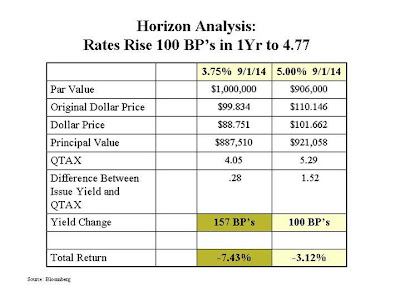
The premium bond would avoid this Market Discount Rule problem and would decline in value by (3.12%) vs. the decline in value of the par bond by (7.43%).
As you can see, the Market Discount Rule can have a very significant impact on total returns in a rising rate environment.
Who Buys Par Bonds?
The primary purchasers of par bonds are bank trust departments and individuals. Bank trust departments buy par bonds because of the nature of the trust relationship. In every trust, there is an income beneficiary and a remainder man. It is the trustee’s responsibility to make sure both parties are treated fairly. Tradition has argued that the best way to ensure fairness is to purchase par bonds. Remember that a bond consists of a series of cash flows. If a premium coupon bond is purchased and all of the income received is paid out, the remainder is less than what the remainder man would ordinarily be entitled to (part of the income is really amortized premium or principal). One has to question this logic, however. Is the remainder man of the trust being treated fairly if the market value of his holdings declines because of the market discount rule? One could argue that the trust department could still buy premium bonds and only pay out that portion to which the income beneficiary is entitled. This approach requires more work for the trust department, but is a lower risk strategy for the trust as a whole.
Retail investors or individuals typically purchase par bonds because they don’t understand how bonds work and they may not have the tools necessary to analyze bond cash flows properly. Bond risks are difficult to measure and not readily understood by many retail investors.
Conclusion
Risk management is a major component of managing a municipal bond portfolio. This example shows that premium coupon bonds are less risky than par bonds because they have less market risk, reinvestment risk is lower in a rising rate environment, and the risk associated with bonds becoming subject to the Market Discount Rule is greater for par bonds.
These are the reasons that most institutions and other savvy investors have been attracted to investing in premium coupon municipal bonds.
Friday, March 9, 2007
Capturing Opportunities Created By An Inefficient Market
Municipal Bonds
The Municipal Bond Market is an inefficient market. Professional money managers develop strategies to add value for their clients by taking advantage of some of these inefficiencies. Let's take a look at some of the possible ways these firms seek to increase their clients' returns with their approach to managing funds.
Inefficiencies
The Muni Market is inefficient in some of these ways:
· Smaller blocks trade cheaper than larger blocks.
· Premium bonds often trade cheaper than par bonds.
· Transaction costs are exorbitant for individuals when dealing with a brokerage firm. SEC and Journal of Fixed Income studies show the bid/ask spreads to be between 2%-2.5% for smaller pieces of Munis. These costs are significantly lower for institutions.
· Taxable munis are inherently better credits than corporate bonds, but trade cheaper than they should. For example, a AAA-rated taxable muni trades at about the same spread vs. treasuries as an A-rated corporate bond.
· There are different levels of access to new negotiated deals. For example, an institutional client has access to new deals from the manager of the issue, but competing dealers do not have access to these deals.
· Muni bonds are a legalized way around the wash-sale rule which creates a 30 day waiting period before buying back the same security.
· Shorter munis trade at lower ratios to treasuries than do longer maturities.
Strategies For Adding Value In An Inefficient Market
Strategy 1
Most Separate Account Managers consider an account to be properly diversified when they have 8-20 different holdings. A $1 million account would need block size of $50,000-$100,000 to be properly diversified. Since smaller lot size blocks of munis trade cheaper than larger lots, one possible strategy would be to buy smaller lots of bonds that fit the needs of this client. Most fixed income money managers prefer to purchase larger blocks of bonds ($1 million+) and allocate them to different accounts. The money manager that buys the smaller lots is able to generate better returns for the client because the securities are being purchased at cheaper prices.
Strategy 2
Muni bonds are primarily issued to fund long-term projects such as schools, hospitals, water, and sewers. Deals come to market with maturities from 1-30 years to fund these projects. However, there is an enormous demand in short-term munis due to tax-free money market accounts. This creates a supply/demand imbalance in the marketplace. This imbalance leads to a difference in the ratio of muni yields vs treasury yields between short maturities and long maturities. For example, today the ratio in 1 year is about 70% while it is about 89% in 30 years. In addition, the Muni Market almost always has an upward sloping yield curve. One way to take advantage of this imbalance is to "borrow short and invest long" on the yield curve. This strategy is employed by Tender Option Bond Programs (TOB's) and closed-end tax-free funds. These strategies are usually highly leveraged and are done in large size.
Conclusion
Each investor should have a strategy for his/her portfolio. Does your strategy include some way of capturing opportunities that have been created by ineffecient markets?
Wednesday, March 7, 2007
Separately Managed Accounts
Tax-Efficiency
Fixed income money managers are also able to implement different strategies for investors or RIA’s that meet the needs of their clients. This may not be the case for a mutual fund. For example, what if you are concerned that stocks might tank and so you want to have a duration target of 7,8,10.0, etc? It is practically impossible to buy a fund that will fit any duration target that you would like to have. Most fixed income portfolio managers can do this relatively easily. Another example would be an endowment fund that doesn't want money invested in what they deem to be socially offensive industries. This may be difficult by using funds, because mutual fund companies such as Pimco, Fidelity, and Vanguard all invest in tobacco or brewing bonds.
Descriptions of these benefits are shown in the table below: